THE BOOK OF COMFORT · AN EXPOSITORY SERIES IN ISAIAH
The God Who Carries
Isaiah 46 · KJV
Babylon’s gods must be carried. Israel’s God carries. Who carries whom?
Review · Chapter 45Tap a card to reveal the answer
Question 0101
In verse 9, why does Isaiah pick the word for unformed, still-wet clay on the wheel — chomer — rather than a word for a finished pot?
↺ Tap to reveal
Answer 01
Because the complaint isn't coming from something that can see the finished result and judge it — it's coming from something still inside a process it can't perceive the shape of. Israel isn't a broken vessel with a legitimate grievance; it's raw material objecting to being handled at all.
↺ Tap to flip back
Question 0202
God says “woe to him that striveth with his maker” in v.9, then says “ask me” in v.11. How is that not a contradiction?
↺ Tap to reveal
Answer 02
The two are separated by posture, not content. Striving demands God justify Himself before trust is extended; asking brings honest questions to God as a petitioner who already trusts Him enough to inquire. Job and Habakkuk both asked hard questions without sinning — the sin is in the demand, not the question.
↺ Tap to flip back
Question 0303
Why does it actually strengthen the case for God's existence that He is “a God that hideth thyself” — rather than one who appears on demand?
↺ Tap to reveal
Answer 03
Because a being who could be consistently, physically observed on request would necessarily be material — locatable, measurable, exhausted by observation. That's the definition of an idol, not of God. Scripture shows God accommodating Himself to human perception at chosen moments (the burning bush, Sinai, the fire) without ever reducing Himself to a physical, on-demand object — and He has, in fact, finally and fully revealed Himself in the Incarnation, on His own terms.
↺ Tap to flip back
“
Even to your old age I am he; and even to hoar hairs will I carry you.
Isaiah 46:4 · KJV
The Big Idea
A carried god cannot carry you.
The gods of Babylon must be borne on weary beasts; the God of Israel bears His people from the womb to old age. The direction of carrying is the whole argument against idolatry.
The Book of ComfortIsaiah 46
Context
The Babylon cluster.
Chapters 44–48 form one sustained argument against the gods of Babylon.
Ch. 44The absurdity of idol-making exposed
Ch. 45Cyrus named as God’s unwitting instrument
Ch. 46The collapse of Babylon’s patron deities
Ch. 47Judgment pronounced on Babylon itself
Ch. 48The stubbornness of Israel that makes comfort necessary
The Book of ComfortIsaiah 40–55 · Section I
The Argument
Five Movements.
One verdict: there is none like Him.
01Idols Are a Burdenvv. 1–2
02God Bears His Peoplevv. 3–4
03No Comparison Standsvv. 5–7
04Remember and Returnvv. 8–11
05Salvation Is Nearvv. 12–13
“
Who carries whom?
Walk through the first seven verses and mark every instance of carrying. What does the direction of carrying tell you about the nature of the god being described?
The Anchor Question
The Gods of Babylon · v. 1
Who were Bel and Nebo?
Bel= Marduk · “lord”
Chief deity and patron god of the city of Babylon — credited with establishing cosmic order and the empire’s dominance.
Neboson of Marduk · scribe of fate
God of writing and wisdom, keeper of the Tablet of Destinies. His name fills royal titles — Nebuchadnezzar, “Nebo protect the crown.”
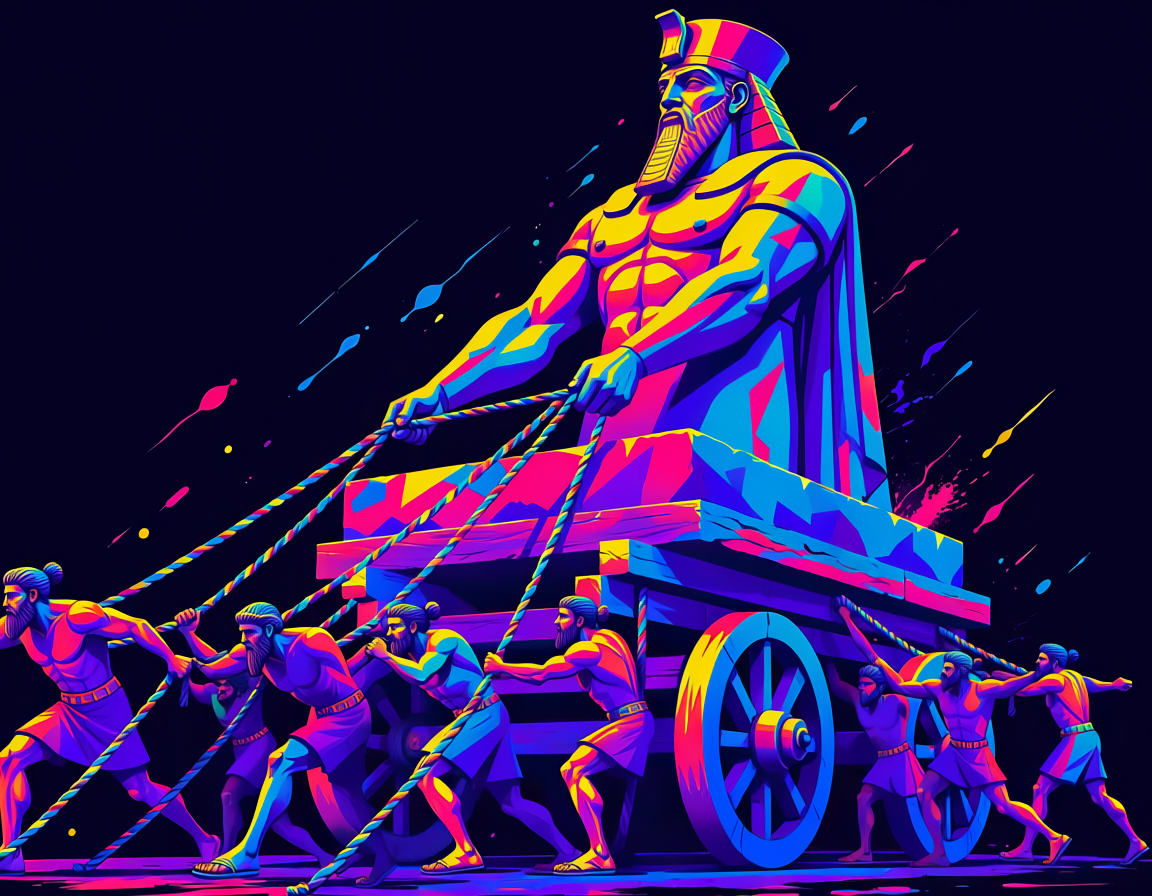
The Akitu festival paraded Marduk’s statue on the shoulders of priests. What Babylon called procession, God calls collapse under the weight of what cannot save.
The Book of ComfortIsaiah 46:1 · Section I
§ I · vv. 1–2
Idols are a burden.
The gods of Babylon cannot even carry themselves.
ReadingIsaiah 46:1–2
“They could not deliver the burden, but themselves are gone into captivity.”
“Bel boweth down, Nebo stoopeth, their idols were upon the beasts, and upon the cattle: your carriages were heavy laden; they are a burden to the weary beast. They stoop, they bow down together…”
The Book of ComfortIsaiah 46:1–2 · KJV
What It Means · vv. 1–2
The weight flows the wrong way.
A god was meant to bear his worshiper. Here the worshiper bears the god — and when crisis comes, the idol is one more piece of luggage dragged into captivity.
“Dagon was fallen upon his face to the ground before the ark of the LORD.”1 Samuel 5:4
Application. Every false god eventually becomes a burden. What we trust for security — wealth, reputation, control — has to be propped up and dragged through every crisis instead of carrying us through it.
The Book of ComfortUnit 1 · vv. 1–2
§ II · vv. 3–4
God bears His people.
The same verb — now reversed. From the belly to the grey hairs.
Review · Chapter 46Tap a card to reveal the answer
Question 0101
In 46:1-2, what happens to the Babylonian gods Bel and Nebo?
A) They are enthroned in glory before the people
B) They are carried off on beasts of burden, unable to deliver themselves
C) They deliver Babylon from the Persian invasion
D) They are melted down and rebuilt as new idols
↺ Tap to reveal
Answer 01 · B
They are carried off on beasts of burden, unable to deliver themselves. “They could not deliver the burden, but themselves are gone into captivity” (v.2).
↺ Tap to flip back
Question 0202
What is the “big idea” contrast we drew from this chapter?
A) A carried god cannot carry you — only the true God carries His people
B) Idols are more reliable than living gods because they are visible
C) Babylon's gods were destroyed before they could be carried away
D) God shares His throne with any idol man creates
↺ Tap to reveal
Answer 02 · A
A carried god cannot carry you — only the true God carries His people. The direction of carrying reveals the nature of the god.
↺ Tap to flip back
Question 0303
Which NT passage connects Isaiah 46 (and 53:4) to the Messiah's work of “bearing” and “carrying”?
A) John 4:24
B) Genesis 1:26
C) Matthew 8:17 and 1 Peter 2:24
D) 1 Samuel 5:1-4
↺ Tap to reveal
Answer 03 · C
Matthew 8:17 and 1 Peter 2:24 — the Servant who bears sickness and sin is the same Servant who bears and carries His people.
↺ Tap to flip back
ReadingIsaiah 46:3–4
“I have made, and I will bear; even I will carry, and will deliver you.”
“Hearken unto me, O house of Jacob… which are borne by me from the belly, which are carried from the womb: and even to your old age I am he; and even to hoar hairs will I carry you.”
The Book of ComfortIsaiah 46:3–4 · KJV
Word Study · vv. 3–4
נָשָׂאnasa
אֲנִי הוּאani hu
“to carry, bear” · “I am he”
nasa is the same verb used for the idol carried on a beast’s back and for God bearing His people through history. The contrast lands because the word is shared.
ani hu — “I am he” — a declaration of unchanging identity (cf. 43:10; 48:12). God is no different at the grey hairs than at the womb. He is the same — and He carries the same.
The Book of ComfortIsaiah 46:3–4
§ III · vv. 5–7
No comparison stands.
“To whom will ye liken me, and make me equal?”
ReadingIsaiah 46:5–7
“One shall cry unto it, yet can it not answer, nor save him out of his trouble.”
“To whom will ye liken me… They bear it upon the shoulder, they carry it, and set it in his place, and it standeth; from his place shall it not remove.”
The Book of ComfortIsaiah 46:5–7 · KJV
What It Means · v. 7
Four things an idol cannot do.
1Cannot move from its place
2Cannot answer when called
3Cannot save out of trouble
4Must be carried to go anywhere
A god you manufacture shares the limits of its manufacturer. It stands where you set it — and cannot move when you need it to. “tzarah” — a tight place. At the moment of maximum need, the idol is silent.
The Book of ComfortUnit 3 · vv. 5–7
§ IV · vv. 8–11
Remember and return.
He declares the end from the beginning — and brings it to pass.
Review · Chapter 46 (cont.)Tap a card to reveal the answer
Question 0101
In vv.3-4, the same Hebrew verb (nasa) used for the idols loaded onto beasts in v.1 is used again for God's action toward Israel. What is God said to be doing with that same word?
A) Judging Israel
B) Carrying Israel
C) Abandoning Israel
D) Punishing Israel
↺ Tap to reveal
Answer 01 · B
Carrying Israel. The contrast is deliberate: the same verb that described the idol being carried (a burden to its worshipers) describes Yahweh carrying His people (vv.3-4) — the direction of the carrying reveals which one is actually God.
↺ Tap to flip back
Question 0202
According to v.7, which of the following is NOT listed as something an idol cannot do?
A) Move from its place
B) Answer when called
C) Reflect its worshiper's own imagination
D) Save out of trouble
↺ Tap to reveal
Answer 02 · C
vv.6-7 list four concrete failures: it cannot move on its own, cannot answer when called, cannot save out of trouble, and must be carried to go anywhere. "Reflecting the worshiper's imagination" was a true observation from discussion, but isn't one of the four failures named in the text.
↺ Tap to flip back
Question 0303
Isaiah 46:9-10 has God appealing to Israel to "remember the former things." What is the basis of that appeal?
A) Israel's own moral effort
B) God's track record of declaring things beforehand and bringing them to pass
C) The wealth used to build the temple
D) A vision Isaiah alone received privately
↺ Tap to reveal
Answer 03 · B
God grounds the appeal in His own demonstrated reliability — "declaring the end from the beginning… my counsel shall stand" — pointing forward to the Cyrus prophecy as evidence that His word has already proven true.
↺ Tap to flip back
ReadingIsaiah 46:9–10
“Declaring the end from the beginning… My counsel shall stand.”
“Remember the former things of old: for I am God, and there is none else; I am God, and there is none like me… and I will do all my pleasure.”
The Book of ComfortIsaiah 46:9–10 · KJV
What It Means · vv. 8–11
Memory breaks rebellion.
“Shew yourselves men” — brace yourselves, take it to heart. The God who named Cyrus before his birth is the God whose word you now hold.
“Calling a ravenous bird from the east, the man that executeth my counsel from a far country.”Isaiah 46:11 · Cyrus, cf. 45:1
Application. His track record is the ground for present trust. Spiritual drift is a drift of memory before it is a drift of action.
The Book of ComfortUnit 4 · vv. 8–11
Word Study · vv. 8–10
הִתְאֹשָׁשׁוּhitashashu
נַגִּידmaggid
“shew yourselves men” · “declaring”
hitashashu — “shew yourselves men” (v.8). A reflexive intensive meaning to brace up, take resolute courage. It is a summons to firm attention, not a suggestion.
maggid, from nagad — “declaring” (v.10). To announce, to set a matter out in front of someone as an established report. God is not predicting in the sense of guessing well — He is publishing settled fact ahead of the event.
The Book of ComfortIsaiah 46:8–10
Word Study · v. 10
אַחֲרִית
acharit“end · latter end · outcome”
A trajectory with a determined terminus — not a vague outline but a settled outcome. The same word gives Jeremiah 29:11 its “expected end.”
“I have spoken it, I will also bring it to pass; I have purposed it, I will also do it.”Isaiah 46:11
The Book of ComfortIsaiah 46:10–11
§ V · vv. 12–13
Salvation is near.
To the stubborn and the far-off, God moves first.
ReadingIsaiah 46:12–13
“I bring near my righteousness… and my salvation shall not tarry.”
“Hearken unto me, ye stouthearted, that are far from righteousness… and I will place salvation in Zion for Israel my glory.”
The Book of ComfortIsaiah 46:12–13 · KJV
Word Study · vv. 12–13
אַבִּירֵי לֵבabbirey lev
צְדָקָהtzedakah
אחרachar
“stouthearted” · “righteousness” · “tarry”
abbirey lev — used elsewhere of powerful bulls (Ps. 22:12). Applied to the heart, it names obstinate strength — not admirable resolve.
tzedakah — both judicial right-standing and active, saving action. Paired with “salvation” because the two are not separate ideas.
achar — to delay, lag behind. “Shall not tarry” puts the timing entirely on God’s own schedule.
The Book of ComfortIsaiah 46:12–13
The Shape of Grace · vv. 12–13
He did not wait for you to soften before He moved.
But His nearness isn’t the end of the matter — it’s the summons to finally do what vv. 8–9 already commanded.
If His nearness was never conditioned on your readiness — what are you still waiting to feel, before you respond to what’s already been brought near?